How Do Mortgage Discount Points Work in Spokane? When Buying Down Your Rate Pays Off (2026)
By Noah Ullah & Jill Larsen · Spokane Best Home Living, brokered by Epique Realty · November 26, 2026
Quick answer: A mortgage discount point is a fee you pay at closing to get a lower interest rate. One point equals 1% of your loan amount, so one point on a $340,000 loan costs $3,400 (Consumer Financial Protection Bureau). Points pay off only if you keep the loan long enough for the monthly savings to cover what you paid up front. To find your break-even point, divide the cost of the points by the monthly savings. In our example below, that takes about five years. For context, Freddie Mac's national 30-year fixed average was 7.21% as of November 25, 2026, down from 7.28% the week before (Freddie Mac PMMS, Nov. 25, 2026). Before you pay points, ask the lender for the same loan with zero points and compare the two.
Hi, it's Noah. On November 13 I filmed a quick video because the rate quotes I was looking at had finally dipped below 7%. Each of those quotes included one discount point, which raises two fair questions for anyone buying in Spokane, Spokane Valley, Liberty Lake or North Spokane this winter: what's a point, and is it worth paying? So Jill and I turned that dated rate post into this evergreen guide. It covers what points are, how to run the break-even math, when a seller can pay them for you, and how points differ from lender credits and builder buydowns.
This is general education, not a loan offer or tax advice. Your actual rate and the price of each point come from your lender and depend on your credit, down payment, loan type and the market on the day you lock.
What is a mortgage discount point?
According to the Consumer Financial Protection Bureau (CFPB), discount points let you trade cash at closing for a lower interest rate. Key facts from the CFPB's explainer:
- One point = 1% of the loan amount. Points don't have to be whole numbers. A lender might quote 0.5 points or 1.375 points.
- Points are paid at closing and are added to your closing costs.
- A loan with one point should have a lower rate than the same kind of loan from the same lender with zero points.
- How much the rate drops per point isn't fixed. It depends on the lender, the loan type and market conditions. Sometimes the drop per point is large, and sometimes it's small.
- Points appear on page 2, Section A of your Loan Estimate and Closing Disclosure. By law, points listed there must be tied to a discounted interest rate.
(CFPB, "How should I use lender credits and points?")
The CFPB also notes that some lenders use the word "points" for any fee figured as a percentage of the loan, whether or not it lowers your rate. If a quote mentions points, ask a simple question: "What rate would I get with zero points?"
What are lender credits?
Lender credits are points in reverse. You accept a higher interest rate, and the lender gives you money toward your closing costs. You pay less up front and more each month. If you're short on cash to close, credits can be the better tool.
How do you figure out if paying points is worth it?
Do the break-even math:
Cost of points ÷ monthly payment savings = months to break even
If you expect to keep the loan longer than that, points may save you money. If you might sell, refinance or pay the loan off sooner, you may never get back what you paid.
A Spokane example with round numbers
We used the $425,000 median closed price for Spokane County in October 2026 (Spokane REALTORS® Market Activity Report, October 2026 closed sales reported through Nov. 8). With 20% down, that's a $340,000 30-year fixed loan. The rate menu below is hypothetical. It's set near Freddie Mac's current 7.21% average to show how the math works. It is not a quote from any lender.
| Option (hypothetical) | Cost (+) or credit (−) at closing | Monthly principal & interest | Difference vs. zero points | Payment break-even |
|---|---|---|---|---|
| 7.50% with a 1-point lender credit | −$3,400 (credit) | about $2,377 | +$58/month | Credit is "used up" in about 59 months |
| 7.25% with zero points | $0 | about $2,319 | — | — |
| 7.00% with 1 point | +$3,400 | about $2,262 | −$57/month | about 59 months (just under 5 years) |
| 6.75% with 2 points | +$6,800 | about $2,205 | −$114/month | about 60 months (5 years) |
Principal and interest only. Property taxes, homeowners insurance, mortgage insurance and HOA dues are not included. Figures are rounded and assume the loan is kept with no extra payments. If one point lowered the rate by only 0.125% (7.25% to 7.125%), the savings would be about $29 a month and break-even would take nearly 10 years.
Here's what the table shows:
- Your timeline matters more than the rate. If you might move for work, upsize when the family grows, or refinance if rates fall, a five-year break-even is a real risk. If this is a home you plan to stay in for 10+ years, points look better.
- The price per point matters. The bottom line in the gray note is the reason to get more than one quote. A point that buys 0.25% is a very different deal from a point that buys 0.125%.
- The cash has other jobs. $3,400 could go toward a larger down payment, an emergency fund, or the furnace and roof items from your inspection. The CFPB's own tip: if you don't know how long you'll keep the loan, and you need your cash for closing and savings, you might skip points.
The CFPB suggests asking a loan officer to show you options with and without points, and to calculate the total cost over three timeframes: the shortest, the longest and the most likely time you'll keep the loan. You can also review options with a HUD-certified housing counselor.
Want to run these numbers on a real home?
Jill and I can help you compare a zero-point quote, a points quote and a lender-credit quote side by side before you write an offer, and look at down payment help too. Get pre-qualified, search Spokane-area homes, or book a free strategy call.
Can the seller pay your points?
Often, yes. Seller-paid points can be a smart thing to negotiate, especially when buyers have more homes to choose from. Spokane County ended October with 1,566 homes for sale and 3.6 months of supply, up from 3.2 months a year earlier (Spokane REALTORS®, October 2026). Every loan program caps how much a seller or other "interested party" can contribute:
- Conventional (Fannie Mae): For a primary residence or second home, financing concessions are capped at 3% of the lower of price or appraised value when the loan-to-value is over 90%, 6% at 75.01–90%, and 9% at 75% or less. Investment properties are capped at 2%. Contributions can't be more than your actual closing costs (Fannie Mae Selling Guide B3-4.1-02).
- FHA: Interested parties may contribute up to 6% of the sales price toward origination fees, other closing costs, prepaid items and discount points (HUD Handbook 4000.1).
- VA: The lender, not VA, sets the rate and points. VA limits seller "concessions" to 4%, but VA says the seller's payment of discount points is not subject to that 4% limit. The VA Lenders Handbook adds a caveat: points beyond what's normal for the market can count as a concession (VA Home Loans, Loan Fees; VA Lender Training, Borrower Fees and Charges).
Your lender applies these rules to your specific file, so loop them in before you finalize an offer.
For sellers: a price cut vs. a credit toward the buyer's points
If you're selling in Spokane Valley or anywhere in the county this winter and a buyer asks for help, the same dollars can land very differently. Using the hypothetical rates from the table ($425,000 price, 20% down, 7.25% zero-point rate):
- A $5,000 price reduction lowers the buyer's loan by $4,000 and their monthly principal and interest by about $27.
- A $5,000 credit toward points buys about 1.47 points on a $340,000 loan. If each point lowered the rate by 0.25%, the rate would drop to about 6.88%, and the payment would fall by about $84 a month.
That doesn't make a credit the right answer every time. A price change also affects the appraisal, your net proceeds and how the listing shows up in searches. But it's worth running both numbers before you counter. For tax purposes, the IRS says a seller can't deduct points paid for the buyer's loan, but those points are a selling expense that reduces the seller's gain (IRS Topic 504). If you're wondering what your home could sell for right now, start with a free home evaluation. For more on timing, see our post should you buy or sell a Spokane Valley home before the holidays?
Are mortgage points tax-deductible?
Sometimes. According to IRS Topic No. 504, Home mortgage points (reviewed Nov. 9, 2026), points are a form of prepaid interest. If you itemize, you may be able to deduct points on a loan to buy or build your main home in the year you pay them, provided several tests are met. Those tests include:
- The points are figured as a percentage of the loan and shown clearly on your settlement statement.
- Paying points is an established practice in the area, and the amount is typical there.
- You bring at least as much of your own money to closing as the points charged.
Points on a refinance or a second home are generally deducted over the life of the loan. If the seller pays your points, the IRS treats them as paid by you, but you subtract them from your cost basis in the home. Many households take the standard deduction instead of itemizing, so this may not change your taxes at all. Check with a tax professional and see IRS Publication 936.
Points vs. a builder rate buydown: what's the difference?
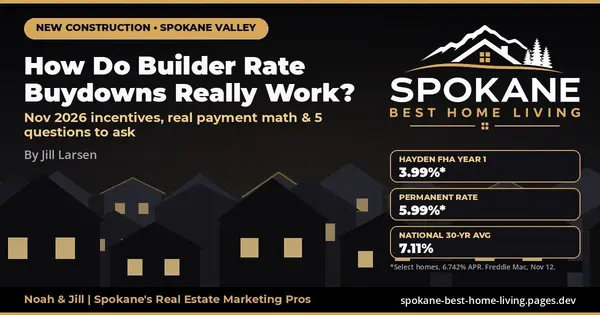
Paying discount points usually buys a permanent lower rate for the life of the loan. Many new-construction promotions instead use a temporary buydown, such as a 2-1, where the rate is lower for the first year or two and then rises to the note rate. Those promotions are usually builder-funded and have their own rules. Jill covers how they work, and the questions to ask a builder, in how builder rate buydowns work in Spokane Valley. If you're comparing a new build with a resale home, compare the payment after the temporary period ends, not just year one.
What should Spokane-area buyers do next?
- Get at least two written Loan Estimates on the same day. Check page 2, Section A for points. Ask each lender for a zero-point version.
- Compare the rate, the APR and your cash to close. The CFPB notes the APR reflects the interest rate, any points, mortgage broker fees and other charges, so it helps when you compare quotes (CFPB, rate vs. APR). Don't decide on the APR alone.
- Run your own break-even for your likely time in the home.
- Know when your rate is locked. The CFPB says locks are typically 30, 45 or 60 days. Extending one can cost money, and a locked rate can still change if your application changes (CFPB, rate locks). Page 1 of the Loan Estimate shows whether your rate is locked.
- Ask about seller credits in your offer if the home has been on the market a while, within your loan program's limits.
- Check down payment assistance before you put scarce cash into points. See whether you qualify on our down payment assistance page.
- Look at the whole market, not just the rate. Our breakdown of what October 2026's Spokane numbers actually show covers sales, prices and supply. We'll update it after the November report.
Watch: the Short that started this
Filmed November 13, 2026. The quotes in this clip (6.75% conventional and 6.20% VA and FHA, each with 1 discount point) were a same-day snapshot, not a rate lock or a commitment to lend. Rates have moved since. Use the current numbers above. Open on YouTube.
FAQ
What is one mortgage point worth?
One point costs 1% of the loan amount, paid at closing. On a $340,000 loan, that's $3,400. How much it lowers your rate depends on the lender, the loan type and the market that day.
How long does it take to break even on mortgage points?
Divide the cost of the points by the monthly savings. In our hypothetical Spokane example, one point ($3,400) saves about $57 a month and takes about 59 months to break even. If the point buys a smaller rate cut, break-even takes longer.
Should I pay points or put more money down?
It depends on how long you'll keep the loan and whether more down payment removes or lowers mortgage insurance. Ask your lender to price both options. If you may move or refinance within a few years, keeping cash or using it for the down payment is often the safer choice.
Can a seller pay for my discount points in Washington?
Yes, within your loan program's limits. Conventional (Fannie Mae) caps run from 3% to 9% depending on your down payment. FHA allows up to 6% of the sales price. VA says normal seller-paid discount points aren't subject to its 4% concession limit. These are federal and agency rules, not Washington-specific ones.
What are mortgage rates in Spokane right now?
Freddie Mac doesn't publish a Spokane-specific average. Its national 30-year fixed average was 7.21% as of November 25, 2026, and the 15-year was 6.54%. That average covers conventional, conforming purchase loans. Your rate will depend on your credit, down payment, loan type and any points you pay, so get a written quote.
Free Guide: A First Time Homebuyer's Guide
A step-by-step guide to buying your first home in the Spokane area, from pre-approval to closing day. Download the free guide.
Work with Noah & Jill
We're Noah Ullah and Jill Larsen, a team at Spokane Best Home Living, brokered by Epique Realty. We focus on Spokane Valley and help buyers and sellers across Spokane County, including Spokane, Liberty Lake and North Spokane. We'd rather help you make a good decision than a fast one, and that includes telling you when paying points doesn't make sense.
Buying
- Search homes: Browse homes for sale
- Get pre-qualified: Start here
- Down payment help: See if you qualify for assistance
Selling
- What's my home worth? Get a free home evaluation or a quick online estimate
Talk with us: Book a free strategy call · (509) 903-5114 · team@spokanebesthomesearch.com
Watch & follow: YouTube · Facebook · Instagram · TikTok
Happy Thanksgiving,
Noah Ullah & Jill Larsen, Spokane Best Home Living
Sources checked November 26, 2026: Freddie Mac Primary Mortgage Market Survey (results as of Nov. 25, 2026); CFPB on points and lender credits (last reviewed Oct. 19, 2023), rate locks (last reviewed Nov. 20, 2026) and interest rate vs. APR (last reviewed Aug. 28, 2026); Spokane REALTORS® Market Activity Report (October 2026 closed sales, reported through Nov. 8, 2026); Fannie Mae Selling Guide B3-4.1-02 (05/07/2025); HUD Handbook 4000.1; VA Home Loans Loan Fees page (updated May 26, 2025) and VA lender training on borrower fees and charges; IRS Topic No. 504 (reviewed Nov. 9, 2026) and Publication 936. Payment examples are hypothetical illustrations calculated by Spokane Best Home Living, not quotes or a commitment to lend. Loan program rules change, so confirm with your lender and tax professional. This article is general information, not lending, legal or tax advice.
Categories
Recent Posts






Managing Broker WADOL 23084
+1(509) 903-5114 | team@spokanebesthomesearch.com